


A Step-by-Step Guide to Verifying a Company’s Registration in Singapore (ACRA BizFile+ Search)
Verifying a company’s legitimacy is a prudent first step before initiating any business relationship. Due diligence is advisable and expected in Singapore’s transparent and well-regulated corporate environment. Whether you are entering a new partnership, evaluating a potential supplier, or assessing a client, conducting a background check can protect your interests and mitigate risk.
Fortunately, the Accounting and Corporate Regulatory Authority (ACRA) offers a reliable and accessible online platform that allows anyone to verify company details with ease.
Why is it Important to Verify a Company’s Credibility Before Doing Business in Singapore?
Verifying a company’s credibility before doing business in Singapore is essential to avoid financial risks. Here are the important factors to verify a company’s credibility before doing business in Singapore:
-
The Regulatory Framework Places Responsibility on the Transacting Party
ACRA maintains a comprehensive public registry of every incorporated entity in Singapore. That accessibility is deliberate, it reflects a policy position that due diligence is not a courtesy extended by the state but a professional obligation assumed by those entering commerce. Businesses that treat verification as optional do so at measurable legal and financial risk.
-
An Unverified Counterparty Exposes You to Contractual Unenforceability
Agreements executed with entities that lack valid corporate standing, whether struck off, wound up, or never registered, may carry no legal force. In the event of default or non-performance, the aggrieved party can find itself without enforceable recourse. Singapore’s courts have limited sympathy for parties who contracted without conducting basic verification.
-
Non-Compliance Records Signal Deeper Governance Failures
A company’s statutory filing history is among the most diagnostic data points available to any prospective partner. Persistent failure to file Annual Returns or convene Annual General Meetings within prescribed timelines is not an administrative footnote. It is a measurable indicator of internal dysfunction, one that correlates reliably with financial instability and elevated counterparty risk.
-
Registered Address Verification Remains a Frequently Overlooked Step
A registered address on ACRA’s records is not automatically a functioning place of business. Nominal mailbox addresses, while legally permissible in certain configurations, offer no guarantee of operational presence. Confirming the nature of a counterparty’s registered address and, where necessary, engaging the address provider directly, remains a standard that too few businesses apply with consistency.
-
GST Registration Requires Independent Confirmation Through IRAS
Company verification through ACRA does not extend to GST standing. An entity collecting Goods and Services Tax without valid registration with the Inland Revenue Authority of Singapore is doing so without legal authority. Input tax claims submitted based on such invoices are routinely disallowed, an outcome with direct cost implications for the paying party that could have been avoided through a single database check.
-
Industry Classification Irregularities Warrant Direct Scrutiny
ACRA’s business registry records each entity’s declared industry activities. An implausibly wide or internally inconsistent range of classifications, spanning unrelated sectors without coherent operational logic, is a recognised indicator of either structural inadequacy or deliberate opacity. Neither characterisation is compatible with the standard of a counterparty that a reputable organisation should be willing to engage.
-
Verification is a Baseline Standard
In Singapore’s commercial environment, due diligence through official registries is not a resource-intensive undertaking reserved for high-value transactions. It is a baseline professional standard applicable to any new vendor, client, or partner relationship. The cost of conducting it is negligible. The cost of omitting it, when circumstances deteriorate, is rarely so.
How Can You Tell if a Singapore-Registered Company is Legitimate?
Singapore has a high average financial loss per scam case, conducting due diligence is a vital step for safeguarding business interests. Some important factors are as follows:
-
Company Status
A “Live” designation confirms the entity maintains active legal standing and retains full capacity to enter binding commercial agreements. Any status other than “Live” warrants immediate scrutiny before proceeding.
-
Industry Classification
An unusually broad or incoherent spread of declared business activities, spanning unrelated sectors without plausible operational justification, may indicate a poorly structured entity or, in more serious cases, deliberate obfuscation of its core commercial purpose.
-
Registered Address
Confirm whether the address on record constitutes a legitimate place of business or merely a nominal correspondence point. Where a virtual or mailbox address is identified, due diligence requires direct engagement with the registered address provider to independently corroborate the entity’s association with that location.
-
Annual Returns
Under the Singapore Companies’ Act, every incorporated entity is legally obligated to file its Annual Return with ACRA within 30 days of its Annual General Meeting. Persistent or repeated failures to meet this statutory deadline are a material indicator of governance deficiency and regulatory disregard.
-
Annual General Meeting
This field records the date on which the company last convened its AGM. A designation of “N.A.” signals that no AGM notification has been submitted to ACRA, a circumstance that, while permissible for qualifying private companies operating under an exemption or dispensation, nonetheless warrants clarification from the counterparty before any commercial commitment is made.
-
Financial Statements
This field reflects the company’s compliance standing with respect to its statutory obligation to submit audited or unaudited financial statements to ACRA. Non-compliance in this area is among the more consequential red flags a verification exercise can surface, one that speaks directly to the transparency and financial accountability of the entity under review.
 Read more about Singapore Company Name Checker
How Do You Verify a Company’s Registration and Legal Status in Singapore?
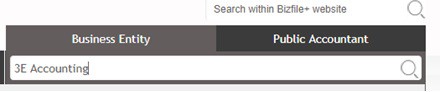
1. Go to ACRA’s free online directory search platform: Online Directory Search
2. Enter the full registered company name exactly as it appears on official documents, invoices, or correspondence.
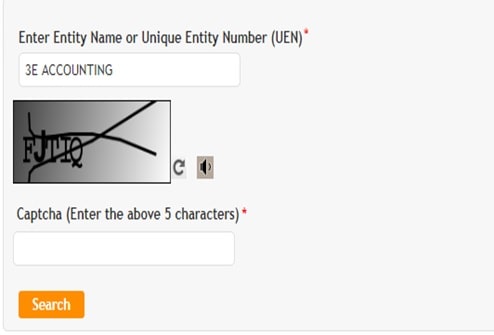
3. You will be prompted to go through CAPTCHA verification (note: CAPTCHA verification is to ensure you are human and not a spam-sending computer).
4. You will then be presented with information related to the company.
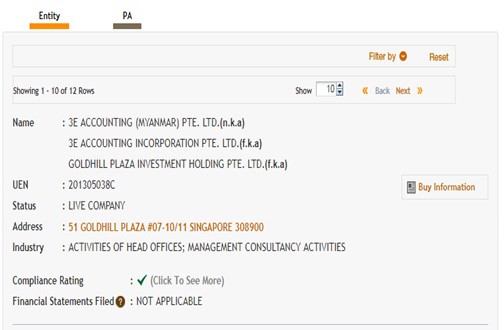
- a) The company’s name, address, UEN and industry
- The registered business address of the company in Singapore will be displayed here. This is particularly useful when running a background check – a wrong registered address / suspicious premise location will raise a red flag.
- b) The business entity’s status
- You will find information about the company’s status. The “live” status is important as it indicates tells whether the company currently exists and is operating.
- c) The entity’s compliance rating for annual filing
- While a green tick indicates that the company complies with the annual filing requirements under the Companies Act, a red cross means otherwise. To be precise, a green tick indicates that the company has held its Annual General Meeting (“AGM”) promptly, presented its latest accounts at the AGM, and filed the Annual Return (“AR”) within 30 days after the AGM.
-
- You can click “click to see more” to find out more information, like the last AR’s date, the last AGM’s date, etc.
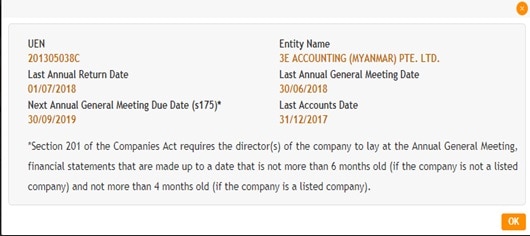
Conducting a background check on any prospective business partner in Singapore is a standard of professional due diligence, one that confirms regulatory standing, identifies compliance gaps, and reduces exposure to fraudulent or financially unstable entities before a commitment is made.
This is the fastest way to verify if a company is registered in Singapore and ensure it meets all Singapore company compliance requirements.
Grounds on Which ACRA May Reject Your Singapore Company Registration
1. Business Name Refusal
ACRA may reject your proposed company name if it:
- Is undesirable or offensive
- Is identical or too similar to existing registered names
- Matches a reserved name or one prohibited by ministerial direction (e.g., “Temasek”)
- May lead to legal disputes, even if initially approved, due to similarity with another entity’s established name.
2. No Registered Singapore Address
Every company must have a physical local address (not a P.O. Box). As per the Companies Act:
- It must be open and accessible for at least 3 hours during business hours on working days.
- Home addresses may be used under the URA/HDB Home Office Scheme, but will be publicly visible.
- Alternatively, consider using a virtual office to maintain privacy while meeting legal requirements.
3. Missing Business Licence
- You must select the correct SSIC code (Singapore Standard Industrial Classification) when registering.
- If your business falls under a regulated sector, you must obtain the relevant licences before registration.
4. Insufficient Shareholders
- A Private Limited Company requires a minimum of 1 and a maximum of 50 shareholders.
- Shareholders can be individuals or entities, local or foreign.
- For an exempt private company, up to 20 individual shareholders are allowed—corporate shareholding is not permitted.
5. No Local Director Appointed
- Every company must have at least one local director, who is:
- A Singapore citizen, PR, or Employment Pass holder.
- At least 18 years old and legally eligible to be a director.
- A Singapore citizen, PR, or Employment Pass holder.
- If unavailable, you may appoint a Nominee Director to fulfil this requirement.
- A qualified company secretary must also be appointed within 6 months of incorporation.
Conclusion
To successfully register a business in Singapore, entrepreneurs must follow a structured process that includes securing name and address approval from ACRA, preparing the necessary documentation, and submitting a complete application. Singapore’s pro-business environment and streamlined regulatory framework make the incorporation journey efficient and entrepreneur-friendly.
For expert guidance and a hassle-free registration experience, consider partnering with 3E Accounting—a trusted firm known for its professionalism, local expertise, and comprehensive corporate services tailored to every business need.
Related Guides:
Singapore Company Name Checker Tool
ACRA Singapore Registrar of Companies
Guide to Select Your Singapore Company Name